Debt Relief Order: what it is, what it costs and who it suits
A debt relief order lasts 12 months. Here is what you pay, what happens to your home and credit file, and the risks — explained without the sales pitch.
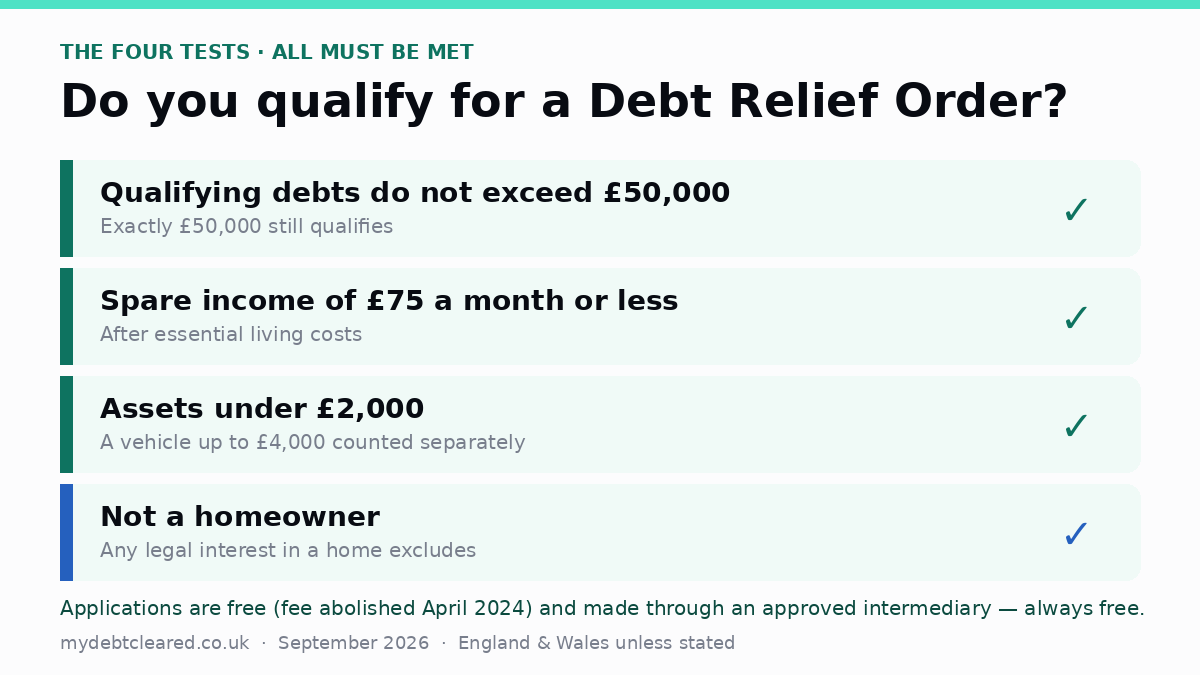
How much does a DRO cost? Nothing.
Since April 2024 there has been no application fee for a Debt Relief Order in England and Wales — the previous £90 fee was abolished. The approved intermediary who submits your application works within the free advice sector and does not charge either. Anyone quoting a fee for “arranging your DRO” is charging for a form the free sector files for nothing; Northern Ireland’s fee position has differed, so confirm it with the intermediary there. The real costs of a DRO are the eligibility constraints and the six-year credit-file entry — not money. Wondering how it differs from a DMP? Is a DRO the same as a DMP? answers it directly; DRO vs bankruptcy covers the other border. In Scotland DROs do not exist — the Scottish equivalent is MAP bankruptcy.
You never have to pay for debt advice. MoneyHelper (government-backed), StepChange, National Debtline and Citizens Advice all give free, confidential advice with no obligation. We would rather you got good advice somewhere than bad advice from anyone. For how a DRO sits alongside the other routes that genuinely erase debt, see writing off debt. Northern Ireland runs its own scheme with matching 2024 limits — the NI DRO guide covers the differences, including what the statute actually says at exactly £50,000.
Checked against current Insolvency Service guidance on Debt Relief Orders. Figures verified 2026-08-14. Primary source · every figure we use.
How it works
None. You pay nothing towards the included debts during the DRO. 12 months. If your circumstances have not improved, the qualifying debts are written off at the end.
| The thresholds, all of which must be met | |
|---|---|
| Qualifying debts | Less than £50,000 |
| Spare income after essential costs | £75 a month or less |
| Total assets | Under £2,000 |
| One vehicle | Excluded if worth under £4,000 |
| Homeowner | Not eligible |
| Previous DRO | None in the past 6 years |
These are absolute. Exceeding any single one of them makes you ineligible, however close you are.
Who it is for
People on a low income with few assets and no realistic prospect of repaying. You must apply through an approved intermediary — usually a free debt advice charity. You cannot apply directly.
What it costs
There is no application fee. The £90 charge was removed in April 2024.
What happens to your home
You cannot normally get a DRO if you own a home. Property ownership takes you outside the asset limit.
What it does to your credit file
Recorded for 6 years from the date the order is made. Listed on the public Individual Insolvency Register.
Protection from creditors
Creditors in the order cannot pursue you or add interest while it runs. At the end, the qualifying debts are discharged.
The risks you need to weigh
- The thresholds are strict and absolute. Go over any one of them and you are ineligible.
- If your circumstances improve during the 12 months, the order can be revoked and the debts come back.
- It is a public record.
- You cannot get another DRO for 6 years.
How it compares
| DRO | IVA | DMP | Bankruptcy | |
|---|---|---|---|---|
| Formal insolvency | Yes | Yes | No | Yes |
| Where it applies | England and Wales (Northern Ireland has its own version with different thresholds) | England, Wales and Northern Ireland | The whole of the UK | England, Wales and Northern Ireland (Scotland calls it sequestration) |
| Typical duration | 12 months | 60 months, or 72 with home equity | Until the debt is repaid — no fixed end | Discharged in 12 months; payments up to 3 years |
| Monthly payments | No payments at all | Monthly, affordability-based | Monthly, flexible, changeable | Only if you have surplus income |
| Your home | Not available to homeowners | Excluded; equity sets the term | Not affected | May be sold |
| Credit file impact | 6 years from the order date | 6 years from the start date | Defaults recorded, 6 years each | 6 years from the order |
| Public register | Listed on the public Individual Insolvency Register. | Listed on the public Individual Insolvency Register, which anyone can search. Your address can be withheld only on evidenced safety grounds. | Nothing public. A DMP is a private arrangement. | Listed on the public Individual Insolvency Register, and in some cases advertised more widely. |
| Fees | Free — no application fee | Paid from your monthly payments | Free providers available | £680 application fee |
| Creditor protection | Full protection, then write-off | Legally binding on included creditors | None — entirely voluntary | Full protection, then discharge |
Not sure which of these applies to you?
Answer eight questions about your circumstances and see which routes are worth understanding, before you speak to anyone.
Common questions
Can I apply for a DRO myself?
No. DRO applications must be made through an approved intermediary, who is almost always an adviser at a free debt charity such as StepChange, Citizens Advice or National Debtline. This is a protection, not an obstacle: it means someone qualified checks whether a DRO is genuinely the right route before you commit to a formal insolvency. Nobody should be charging you for a DRO application.
What if my circumstances improve during the 12 months?
You have a duty to tell the Official Receiver. If your income or assets rise above the limits, the order can be revoked and the debts return in full. This is worth thinking about honestly before applying — if you expect a job, an inheritance or a relationship change within the year, discuss it with your adviser first.
Which debts do not count towards the £50,000?
Some debts are excluded from the DRO entirely and therefore do not count towards the limit — student loans, court fines, child maintenance, and debts arising from personal injury claims among them. They also survive the DRO, so you still owe them at the end. Your intermediary will identify which of your debts qualify.
Related guides
We are a marketing introducer. We publish information and, if you ask us to, we pass your details to an FCA-authorised debt advice firm we work with so they can contact you. We do not give debt advice, we do not provide debt solutions, and we do not decide whether any solution is right for you. We are paid by the firms we introduce people to, never by you. Read exactly how we make money.