Council tax arrears: what happens, and what you can actually do
Council tax is a priority debt and it escalates faster than almost anything else. Here is the escalation process in order, what your rights are, and how this debt is treated in each UK debt solution.
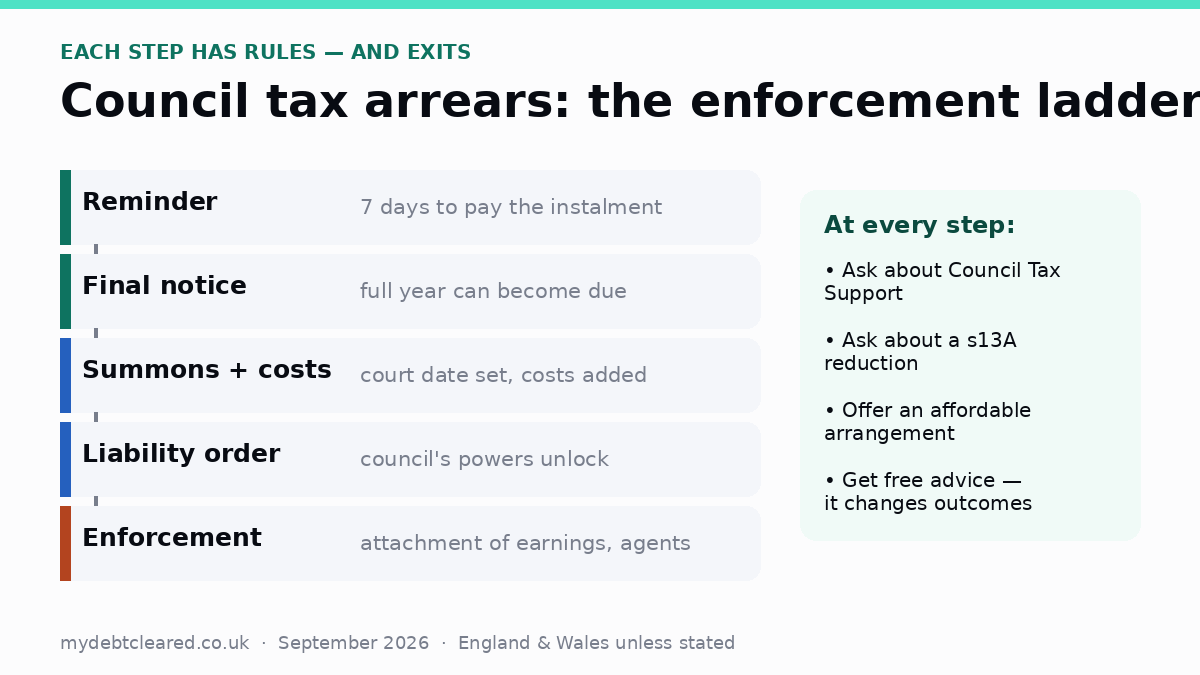
Every stage, covered properly
You never have to pay for debt advice. MoneyHelper (government-backed), StepChange, National Debtline and Citizens Advice all give free, confidential advice with no obligation. We would rather you got good advice somewhere than bad advice from anyone. Not sure any of this needs to be faced alone? Free debt advice lists every route to a real adviser at no cost.
Where this debt sits in the hierarchy
The consequence of not paying is losing something essential — your home, your supply, your goods, or in rare cases your liberty. Priority debts come before credit cards, loans, overdrafts and catalogues, however aggressive the letters from those creditors are.
What actually happens, in order
You miss an instalment
The council sends a reminder giving you seven days to pay.
You do not pay within seven days
You lose the right to pay by instalments. The whole remaining year becomes payable.
A final notice
Then the council applies to the magistrates' court for a liability order. Court costs are added to what you owe.
Liability order granted
The council can now instruct enforcement agents, apply for an attachment of earnings, take deductions from certain benefits, or apply for a charging order.
Enforcement agents
A compliance fee of £79 is added, then £247 at the enforcement stage, then more again if goods are removed for sale. These rose on 1 May 2026.
What people are not usually told
Two things almost nobody is told. First, ask the council about a discretionary reduction under section 13A of the Local Government Finance Act 1992 — councils have a power to reduce or cancel a council tax bill in cases of hardship, and it is used far less than it should be because few people know to ask. Second, check whether you are entitled to Council Tax Reduction, a single person discount, a disregard for a severely mentally impaired resident, or a student exemption. Backdating is sometimes possible. Getting the bill right is often worth more than any repayment arrangement.
How this debt is treated in each solution
Every formal solution handles debts differently, and this one is no exception.
| IVA | DMP | DRO | Bankruptcy | |
|---|---|---|---|---|
| Formal insolvency | Yes | No | Yes | Yes |
| Where it applies | England, Wales and Northern Ireland | The whole of the UK | England and Wales (Northern Ireland has its own version with different thresholds) | England, Wales and Northern Ireland (Scotland calls it sequestration) |
| Typical duration | 60 months, or 72 with home equity | Until the debt is repaid — no fixed end | 12 months | Discharged in 12 months; payments up to 3 years |
| Monthly payments | Monthly, affordability-based | Monthly, flexible, changeable | No payments at all | Only if you have surplus income |
| Your home | Excluded; equity sets the term | Not affected | Not available to homeowners | May be sold |
| Credit file impact | 6 years from the start date | Defaults recorded, 6 years each | 6 years from the order date | 6 years from the order |
| Public register | Listed on the public Individual Insolvency Register, which anyone can search. Your address can be withheld only on evidenced safety grounds. | Nothing public. A DMP is a private arrangement. | Listed on the public Individual Insolvency Register. | Listed on the public Individual Insolvency Register, and in some cases advertised more widely. |
| Fees | Paid from your monthly payments | Free providers available | Free — no application fee | £680 application fee |
| Creditor protection | Legally binding on included creditors | None — entirely voluntary | Full protection, then write-off | Full protection, then discharge |
Arrears existing at the start date can usually be included in a formal solution. Ongoing liabilities — this year's council tax, current rent, current energy usage — cannot be, and must be budgeted for separately.
Not sure which of these applies to you?
Answer eight questions about your circumstances and see which routes are worth understanding, before you speak to anyone.
Common questions
Can I go to prison for council tax arrears?
Committal to prison is theoretically possible in England for wilful refusal or culpable neglect after a liability order, but it is rare, it requires a means enquiry at the magistrates' court, and it cannot be used where you genuinely cannot pay. It has been abolished in Wales. If you receive a committal summons, get advice immediately — free advice, that day.
Can council tax arrears go into an IVA or DRO?
Arrears that exist when the arrangement starts can usually be included in an IVA, a DRO or bankruptcy. Council tax for the current and future years cannot be — that remains an ongoing liability you must pay. This is one of the most common reasons people fall out of an otherwise workable arrangement.
Can I negotiate a payment plan after a liability order?
Yes, and you should try before enforcement agents are instructed. Councils can and do accept arrangements at that stage. Once the account is passed to enforcement agents, fees have already been added and the council will usually refer you back to the agent, so acting before that point saves real money.
Related guides
We are a marketing introducer. We publish information and, if you ask us to, we pass your details to an FCA-authorised debt advice firm we work with so they can contact you. We do not give debt advice, we do not provide debt solutions, and we do not decide whether any solution is right for you. We are paid by the firms we introduce people to, never by you. Read exactly how we make money.